Guide to Leaky Roof Repair Cost
MEGA MEGA • November 3, 2026
Learn what affects leaky roof repair cost, what a roofer checks, and how to compare estimates and plan a safe next step for your property.

Leaky roof repair cost depends on what is allowing water in, how far it has traveled, and what a roofer must do to reach and repair the affected area. The stain on a ceiling is only one clue; it does not establish the roof opening or the full repair scope. Understanding the questions behind an estimate can help you compare proposals without relying on a generic price.
What does leaky roof repair cost depend on?
A repair estimate is based on the conditions at the property, not just the size of an indoor stain. Water can enter at one point and travel along the roof deck, framing, or other surfaces before appearing inside. The roofer needs to identify a likely entry point, determine what materials are involved, and explain what can and cannot be confirmed before the repair area is opened.
These are common factors that change the scope:
- Source of the leak: A damaged shingle, failed flashing, roof valley, vent, skylight, chimney, or wall transition calls for different materials and work.
- Extent of affected roofing: A localized repair is different from a repair that must extend beyond the first visible defect to reach sound materials.
- Condition beneath the roof covering: Underlayment or decking may be affected if water has entered for some time. Some concealed conditions only become clear after material is lifted or removed.
- Roof layout and access: Height, pitch, obstacles, and the location of the repair affect setup and safe access.
- Material type and compatibility: The existing roofing system and availability of compatible replacement materials influence the repair plan.
- Temporary protection: An active leak may need an interim measure before a lasting repair can be completed.
- Interior work: Ceiling, insulation, or other interior repairs may be separate from the roofing scope.
These factors are why two leaks that look similar from a bedroom can lead to different recommendations. For a broader comparison of a localized repair and a larger project, read this guide to repairing or replacing a roof. The best choice depends on the roof's actual condition, not the stain alone.
Why might a ceiling stain not show where the leak starts?
Water can move sideways as well as downward. It may run along roof decking, rafters, insulation, or a wall before becoming visible. A mark near an exterior wall, for example, does not prove water entered directly above it. Rain driven by wind can also reach a roof transition or flashing detail that remains dry during calmer weather.
For this reason, avoid treating the visible stain as a repair location. Applying sealant to a convenient spot indoors or outdoors may cover a symptom without correcting the entry point. A roofer may need to evaluate nearby roof details and compare them with the timing and location of the indoor evidence. If you want to understand safe first steps and what details to share, review what to do first with a roof leak in Georgia and how to find a roof leak.
What information should you gather before requesting an estimate?
You do not need to diagnose the roof yourself. A concise record of what you have observed helps the roofer ask better questions and understand whether water is still entering.
- When you first noticed the problem: A date or approximate timeframe is useful, especially if the mark has changed.
- Weather conditions: Note whether it appears during steady rain, wind-driven rain, or after a particular storm.
- Where water appears indoors: Identify the room and the approximate location. If more than one area is affected, list each one.
- Whether the leak is active: Say if you see a drip now, if the area is damp, or if the stain is old and currently dry.
- Earlier repairs: Share any prior patching, roof work, or recurring leak history that you know about.
- Photos from safe places: Indoor photos can document a stain. Exterior photos should be taken from the ground, not from a roof or ladder.
Keep your notes factual. If you do not know whether the water came through a roof vent or a wall joint, say that you are unsure. Guessing may send attention toward the wrong detail. A guide to roof repair advice for Georgia property owners offers more context about describing a repair concern.
What should a roofer check before estimating the repair?
A useful assessment connects the indoor signs with visible roof conditions and the home's layout. The roofer may ask when the leak occurs, what rooms are affected, and whether the problem follows wind or heavy rain. Then the roof covering, transitions, and areas around penetrations can be evaluated as appropriate.
Roof covering and transitions
On an asphalt-shingle roof, the roofer may look for missing, cracked, lifted, or damaged shingles. They may also examine valleys, roof edges, vents, chimneys, skylights, and points where the roof meets a wall. These transitions rely on carefully integrated materials, so a leak may involve flashing or the connection between components rather than the broad roof surface.
Do not assume a defect will be visible from the driveway. A ground-level view may help document obvious damage, but it does not replace an assessment of the affected detail. If a skylight is near the leak, see the separate skylight leak repair guide for questions specific to that assembly.
Materials beneath the visible surface
The condition of underlayment and decking can affect how much work is needed. If the roofer suspects damage below the shingles, ask how it will be assessed and what happens if it is more extensive than expected. It may not be possible to confirm every concealed condition until the roof covering is opened. A clear estimate should explain that uncertainty rather than imply that unseen materials have already been verified.
Interior clues and roof history
Interior staining, damp insulation, or a soft area may offer clues, but they do not by themselves identify the source. Tell the roofer if the leak has appeared in the same place before or if a previous repair changed the symptoms. If the concern is near a chimney, the chimney flashing repair guide explains why this roof-to-wall detail deserves a specific evaluation.
What should a roof repair estimate explain?
Ask for a written description that lets you see what work is proposed and what is outside the scope. Estimates are difficult to compare when one describes a suspected cause and another lists only a general repair. You should be able to understand the proposed steps without needing to interpret technical shorthand.
- Suspected source: What condition does the roofer believe is allowing water in, and what observations support that assessment?
- Repair area: Which part of the roof is included? Does the work stop at a specific boundary or extend to nearby components?
- Materials and work: Which shingles, flashing, underlayment, or other parts are to be repaired or replaced?
- Temporary or permanent scope: Is the proposal for interim protection, a lasting repair, or both?
- Unconfirmed conditions: What may be discovered only after opening the roof, and how will you be informed?
- Exclusions: Does the estimate include interior repairs, cleanup, or work on adjacent components? If not, ask what is excluded.
- Protection and timing: How will the home and work area be protected, and what weather or material conditions could affect scheduling?
- Documentation and payment terms: What written records and terms will you receive before work begins?
If concealed damage is found, ask that the contractor explain the condition, proposed added work, and any change to the estimate before proceeding. This gives you a chance to understand the difference between the initial scope and the revised scope. Do not treat a verbal description such as “we will fix whatever we find” as a substitute for clear communication about additional work.
How can you compare repair proposals fairly?
Compare the work being offered, not only the total. A proposal with a higher amount may include a broader repair area or materials another proposal leaves out. A lower amount may be appropriate for a simple, clearly defined repair, but a short description does not show whether two contractors are solving the same problem.
Compare the diagnosis
Start by checking whether each roofer identifies the same suspected entry point. If the explanations differ, ask each person to describe the evidence and any uncertainty. A leak can be difficult to trace, so a careful explanation of what remains unknown is more useful than an unsupported guarantee that a quick patch will solve it.
Compare boundaries and materials
Look for the repair area's limits and the components included. One estimate might address a shingle and the nearby flashing; another might only describe replacing a few shingles. Ask whether the materials will be compatible with the existing roof and whether the scope includes removing and reinstalling material needed to reach the defect.
Compare contingency handling
Find out how each contractor handles unexpected conditions under the surface. Ask who will contact you, how the added work will be described, and whether you will have a chance to approve a revised scope. This is a practical point to settle before work starts, not after the roof has been opened.
Compare the outcome each proposal is meant to achieve
Ask whether the contractor expects the work to be a lasting repair or a temporary measure. If a proposal is intentionally limited, understand why and what follow-up might be needed. Compare timing, protection, and cleanup as well as the repair itself. If you are weighing a repair against a broader project, use the repair-versus-replacement discussion as background, then ask for the reasoning tied to your roof.
For homeowners with asphalt shingles, roof age and prior repairs can be useful context, but they are not a diagnosis. Read about asphalt shingle lifespan to understand aging considerations. A roof's condition, leak source, and repair feasibility still need to be evaluated at the property.
How do access and property type affect the scope?
Roof height, pitch, shape, and nearby obstacles can change how a repair is set up. A small damaged area on a straightforward roof is not automatically the same job as a small area on a steep roof or one with limited access. Safe access and protection of surrounding surfaces are part of planning the work.
Property type matters too. A low-slope commercial roof may use a different roofing assembly and drainage approach from a home with asphalt shingles. The repair needs to match that roof system rather than borrow assumptions from a different material. Property managers can review the commercial flat roofing guide for background on commercial roof details.
If you manage a property or coordinate work for an owner, gather the same basic information: where water appears, when it happens, what areas are affected, and what earlier repairs are documented. Make sure the person authorizing work understands the proposed scope and how changes will be communicated. A clear written record can help keep building contacts, occupants, and contractors aligned.
When is temporary protection appropriate?
If water is actively entering, temporary protection may help limit further exposure until a permanent repair can be made. It should be understood as an interim step, not proof that the underlying cause is resolved. Ask what the measure covers, what conditions could affect it, and what follow-up work is recommended.
Do not climb onto a wet, steep, or damaged roof to place a tarp or apply a patch. Falls are a serious hazard in construction work; OSHA provides workplace safety information at its official site. If you cannot reach an area safely, leave the roof work to qualified professionals. A roofer can advise whether temporary protection is feasible and how it relates to a lasting repair.
After severe weather, document visible conditions from indoors or the ground and keep relevant receipts and prior repair records. If you are considering an insurance claim, read this guide to hail damage and roof insurance claims. Coverage depends on the policy, the cause of damage, and the insurer's review; a contractor cannot promise that a claim will be approved.
What can you do while waiting for roof work?
Focus on protecting people and belongings without taking on unsafe roof work. If water is coming in, the following steps can help you keep track of the problem and reduce avoidable damage:
- Move furniture and belongings away from the water if it is safe to do so.
- Place a container beneath a drip and use towels for small amounts of water, while avoiding any sagging ceiling.
- Keep people away from bulging ceilings, wet electrical fixtures, and unstable areas.
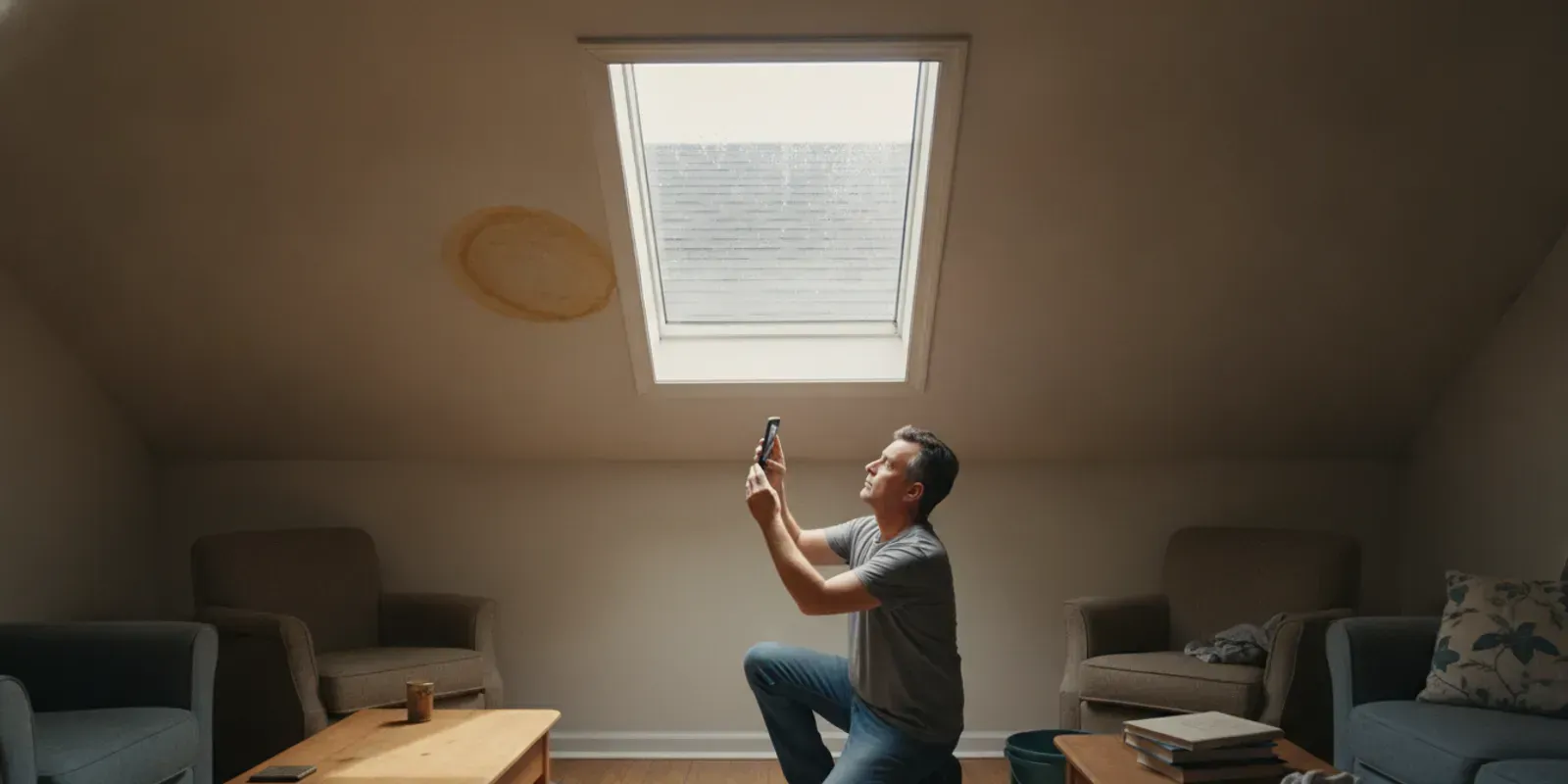
- Take photographs of the interior condition from a safe location and note the date and weather.
- Describe whether water is actively entering when you contact a roofer.
- Save earlier repair paperwork and make a list of questions about scope, access, and concealed damage.
If water is near electrical equipment, do not touch wet equipment or standing water; contact an appropriate professional for help. Do not cut into a ceiling or remove roofing materials as a way to trace the leak. The goal while waiting is to record what is happening and keep people clear of hazards, not to make a potentially unsafe diagnosis.
How do you decide on a next step?
Once you have an estimate, make sure you can answer four practical questions: What is the suspected source? What exactly will be repaired? What could change after materials are opened? How will the contractor get your approval if the scope changes? If those answers are missing, ask for clarification before authorizing the work.
There is no need to choose a proposal based only on a broad online price range. The same indoor symptom can come from different roof details, and the full condition may not be known until a roofer evaluates the site. For a homeowner or property decision-maker in the area, a residential roof repair service overview can help explain the type of work to discuss. You can also review examples of roofing work to see common project contexts.
How do common leak situations lead to different estimates?
Consider two homeowners who both notice a brown mark after rain. The first has a small, recent stain below a roof area where one shingle is visibly displaced. The second has a recurring stain near a chimney, plus a history of earlier patching. The indoor evidence looks similar at first, but the likely roof details and amount of investigation differ. These examples do not predict a specific price; they show why an on-site scope matters.
A localized shingle problem
If the roofer finds a limited defect in an otherwise serviceable area, the proposed work may focus on lifting or removing the affected shingles, checking the nearby materials, and restoring the roof covering with compatible components. Ask how far the repair will extend and whether the roofer expects to find damage below the surface. Even a visibly small defect needs an adequate repair boundary; simply covering the exact spot without checking adjacent materials may not address the cause.
A leak near a chimney or roof transition
A recurring leak around a chimney or wall connection may involve flashing, adjacent shingles, or more than one roof detail. The roofer may need to inspect how those components meet and whether an earlier patch changed the way water moves. In this situation, compare proposals carefully: one could describe a narrow surface patch while another addresses the flashing assembly and nearby roofing. Ask each contractor to explain which condition they observed and why the proposed area is appropriate.
A leak with possible concealed damage
If water has been entering over time, visible staining may not show the condition of the roof deck or interior materials. An estimate may therefore identify a defined initial scope and explain how additional concealed damage will be handled if it appears after opening the roof. Before work begins, agree on how the roofer will pause, document the finding, explain the added work, and obtain authorization. This communication process is especially helpful when a property owner, manager, or other decision-maker is not on site during the repair.
The comparison is not about deciding which scenario you have from a photograph. It is a way to ask better questions: Is the suspected entry point clear? What components are included? What may change once materials are opened? Does the proposal distinguish immediate protection from permanent repair? Answers to those questions help you understand the basis of an estimate without treating a general online range as a quote for your roof.
What questions help prevent confusion after work begins?
Many disagreements start with different expectations about what a repair includes. Before authorizing work, take a few minutes to confirm the plan in plain language. You can use these questions whether you own a home, manage a building, or are coordinating for another property owner:
- Where does the roofer believe water is entering, and what evidence points to that location?
- What parts of the roof will be removed, repaired, or replaced?
- What condition would cause the planned repair to expand?
- How will I see or hear about concealed damage before added work proceeds?
- Does the scope include a temporary measure, the permanent repair, or both?
- What indoor or adjacent-area work is not included in this roofing estimate?
- Who should I contact if the leak returns or the symptoms change?
Write down the answers or keep the estimate and related messages together. If a property has more than one decision-maker, share the scope with everyone who needs to authorize or coordinate the work. Clear notes also make it easier to compare a revised proposal with the original one. The goal is not to make a contractor promise that no hidden issue can occur; it is to establish a transparent process for addressing one if it does.
Frequently asked questions
Can a roofer determine leaky roof repair cost from a photograph?
A photograph can show a stain or visible roof damage, but it may not confirm where water entered or whether materials beneath the roof covering are affected. A site assessment may be needed to define the repair and identify what remains uncertain.
Does a small ceiling stain mean the repair will be small?
Not necessarily. The stain marks where water became visible indoors, not necessarily where it entered or how far it traveled. The roof detail and condition of materials around it determine the necessary scope.
Should I ask for a repair or full roof replacement?
Ask the roofer to explain the roof's overall condition, the leak location, and whether a durable localized repair is feasible. A leak alone does not establish that the whole roof needs replacement, and age alone does not prove a repair will be adequate.
Will homeowners insurance pay for a roof leak?
That depends on the cause of the damage, the policy terms, and the insurer's decision. Document what you observe and ask your insurer about coverage. Do not assume gradual wear and sudden storm damage are treated the same way.
What should I do if water is still coming in?
Protect belongings if safe, keep clear of electrical hazards and unstable ceilings, and contact a roofing professional to discuss the active leak and temporary protection. Do not climb onto a wet or damaged roof.
A clear assessment and written scope can help you understand the repair, compare proposals, and choose a safe next step for your property.